How Many Estimated Art Pieces Did Leonardo Da Vinci Leonardo Da Vinci Artwork
A Leonardo da Vinci painting has sold for a record-breaking $450 one thousand thousand this week, at Christie's sale house in New York. The figure more than doubles the existing record for an artwork sold at auction: a $179.4 million bid for a Picasso in 2015.
The painting - a depiction of Jesus called Salvator Mundi - sold for the comparatively small sum of $x,000 12 years agone. Some experts believed it had been painted by ane of Da Vinci'south followers.
There are some critics who even so question the work'south authorship, but the majority of scholars believe it be authentic.
The doubts did not dampen the 19 minutes of bidding, during which the painting climbed from a guaranteed pre-sale bid of $100 million.

Prototype: REUTERS
Salvator Mundi is the merely Da Vinci painting in individual hands and is i of fewer than 20 the erstwhile master painted in oil.
Male monarch Louis XII of France deputed the 44cm x 66cm painting in 1605, during the same menses every bit the Mona Lisa. Information technology was subsequently recorded in King Charles I of England's drove. Betwixt 1763 and 1900 information technology disappeared, until it was bought at auction past a British art collector. The confront and hair of the discipline had been painted over, making it look like a copy. It was presumed to exist by a follower of Da Vinci called Bernandino Luini.
The London fine art collector'south family unit sold information technology in 1958 for a paltry £45.
In 2005, a group of art dealers acquired information technology for $10,000. They spent half dozen years restoring and investigating the painting earlier declaring it was by Leonardo himself. London'due south National Gallery exhibited it in 2011. Information technology was the showtime "discovery" of a Da Vinci since 1909, and became known equally the "lost Leonardo".
9 other jaw-droppingly expensive artworks
2. Interchange by Willem de Kooning, $300 1000000

This abstract landscape by the Dutch-American painter commanded the highest price ever paid in a private sale for an artwork. Hedge fund billionaire Kenneth C Griffin bought it, spending $200 million on Jackson Pollock'due south Number 17A at the same fourth dimension. (Come across number five below).
three. The Carte Players past Paul Cézanne, $250 million
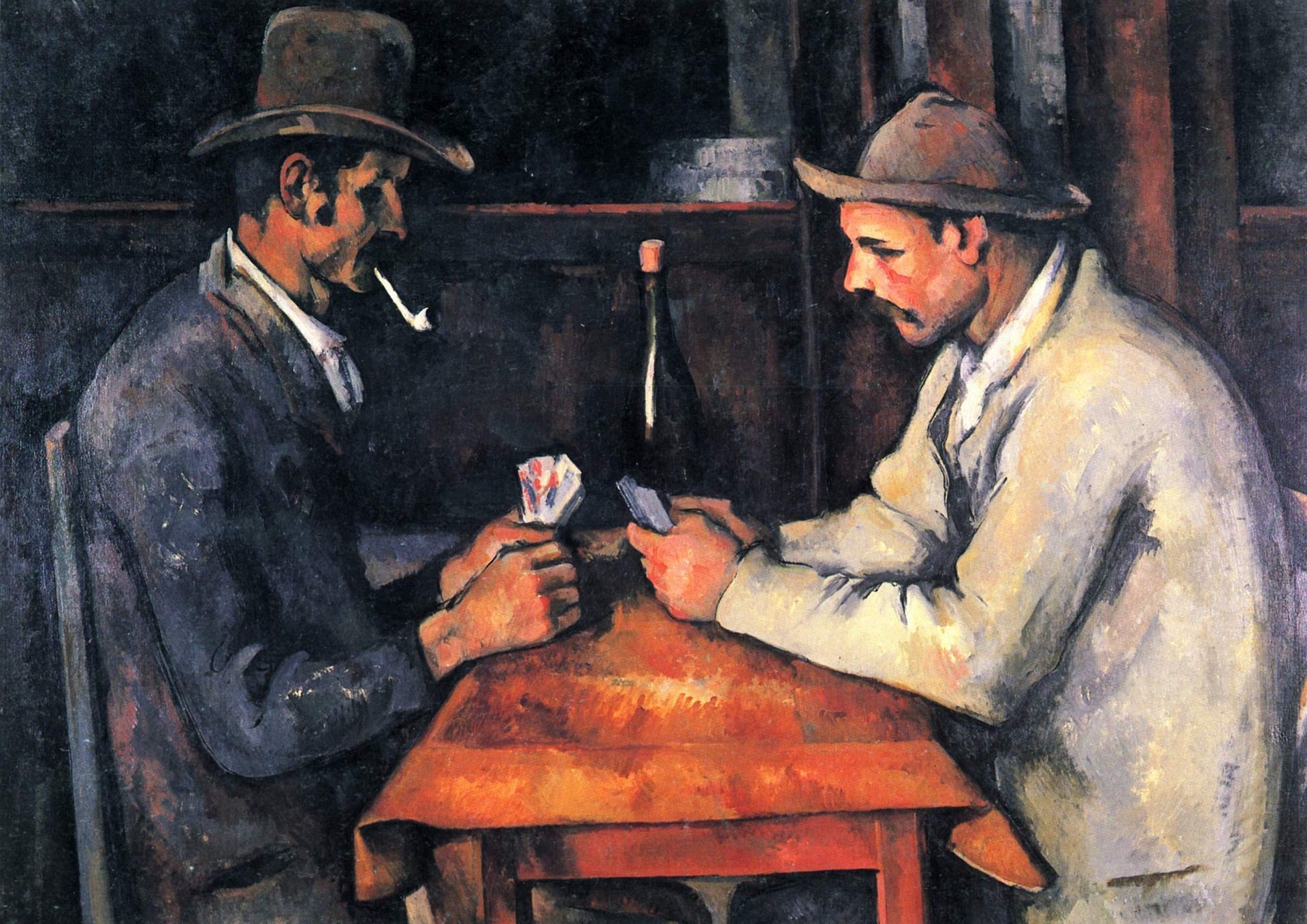
When Qatar's Imperial Family unit bought one of Cézanne'due south 5 versions of this scene in 2011, they paid double the existing record for an artwork at auction. The men who posed for the painting included farmhands on Cézanne's manor, who may take been surprised by the price their depiction reached.
4. Nafea Fan Ipoipo (When Will Yous Ally?) by Paul Gauguin, $210 million
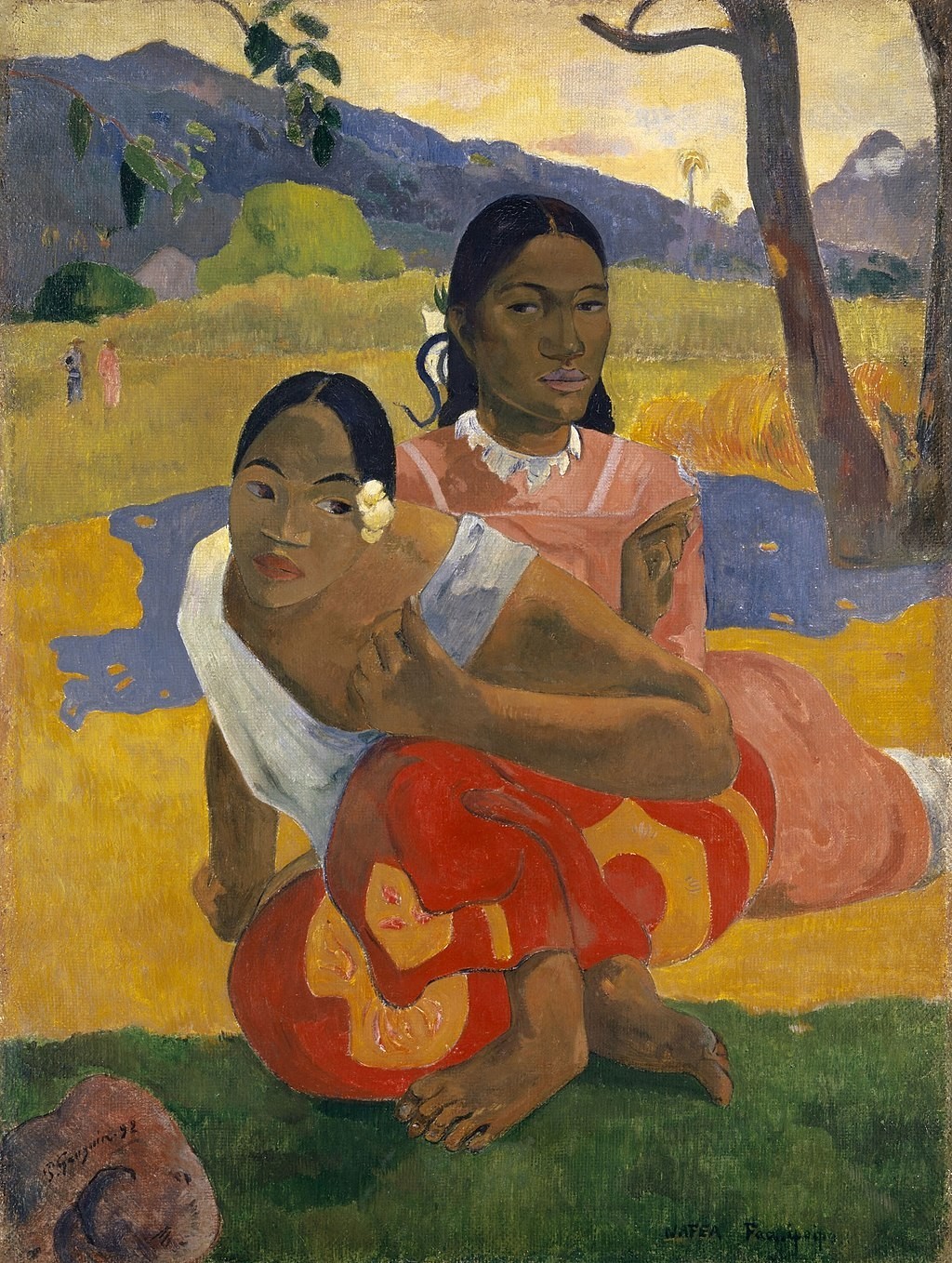
French post-Impressionist artist Paul Gauguin painted it during his offset trip to Tahiti, where he later lived for 6 years. When the artwork changed hands - later ii years of negotiations - for a reported $300 meg in 2015, it was called the most expensive painting ever sold. But a Loftier Courtroom lawsuit over an alleged outstanding $10 million auction commission revealed the heir-apparent had paid just $210 million.
5. Number 17A by Jackson Pollock, $200 million

This was the second artwork bought in a 2015 $500 million deal by hedge fund manager Kenneth C Griffin. Pollock, an American abstract-impressionist known for his style of drip painting, also created the 11th nigh valuable artwork, No. 5, 1948. It sold for $140 million in 2006.
6. No. 6 (Violet, Green and Red) past Mark Rothko, $186 million

This painting, along with 36 others, is part of an ongoing court battle brought past its buyer, Russian fertilizer tycoon Dmitry Rybolovlev, against his art dealer, Yves Bouvier. Rybolovlev has defendant the dealer of defrauding him to the melody of hundreds of millions past overcharging him for paintings caused on his behalf. Bouvier denies all charges.
vii. Pair of portraits of Maerten Soolmans and Oopjen Coppit by Rembrandt, $180 1000000

Prototype: REUTERS/Etienne Laurent/Pool
Rembrants painted the portraits to celebrate the wedding of Maerten and Oopjen in 1634. The pictures have never been separated. They were bought in a joint buy by the Louvre and the Rijksmuseum in 2015, with each gallery contributing 50%.
eight. Les Femmes d'Algers ("Version O") by Pablo Picasso, $179.iv million

Image: REUTERS/Darren Ornitz
Inspired by Delacroix'due south Les Femmes d'Algers (The Women of Algiers), this was the last of 15 versions Picasso painted. He started the series half-dozen weeks after his fellow artist Henri Matisse died, and considered it a tribute to Matisse'south manner. It held the tape for about expensive artwork sold at auction for more than two years, before Salvator Mundi was sold for $450.3 one thousand thousand.
9. Nu Couché past Amedeo Modigliani, $170.4 million

Image: REUTERS/Paul Hanna
Depicting a naked woman on a red sofa, this painting caused a scandal when information technology was first shown in Paris in 1917. Afterwards a crowd formed outside the gallery hosting Modigliani'south commencement (and merely) solo prove, the police force arrived and shut down the exhibition immediately. It was bought by Chinese former taxi driver-turned-stock-market-billionaire Liu Yiqian to display in his ain museums in Shanghai.
10. Masterpiece by Roy Lichtenstein, $165 1000000

Masterpiece was a satirical commentary on Lichtenstein's ain career, which was taking off when he made the artwork in 1962. Masterpiece's seller, philanthropist Agnes Gund, used proceeds from its purchase in 2017 by hedge fund founder Steve Cohen to kickoff a fund for criminal justice reform called Art for Justice. Information technology aims to reduce mass incarceration.
williamsexate1974.blogspot.com
Source: https://www.weforum.org/agenda/2017/11/leonardo-da-vinci-most-expensive-artworks/
0 Response to "How Many Estimated Art Pieces Did Leonardo Da Vinci Leonardo Da Vinci Artwork"
Post a Comment